Problem and user
Identify the recurring workflow, current alternative, buyer, user, and reason distributed infrastructure improves the outcome.
Research hub
A practical research system for understanding blockchain products, networks, tokens, companies, and market infrastructure without compressing technical progress into an investment conclusion.
Blockchain opportunities combine software, incentives, operating controls, legal entities, counterparties, and market structure. Each lens answers a different question.
Identify the recurring workflow, current alternative, buyer, user, and reason distributed infrastructure improves the outcome.
Map consensus, data availability, smart contracts, oracles, bridges, upgrade paths, administrative keys, and failure recovery.
Trace payments, costs, subsidies, supply, ownership, fees, treasury flows, and the instrument that participates in value.
Document formal rights, practical influence, voting concentration, emergency powers, entities, and service-provider authority.
Test custody, liquidity, redemption, settlement, vendor concentration, monitoring, incident response, and business continuity.
Define the exposure’s job, loss budget, time horizon, dependencies, catalysts, monitoring thresholds, and exit conditions.
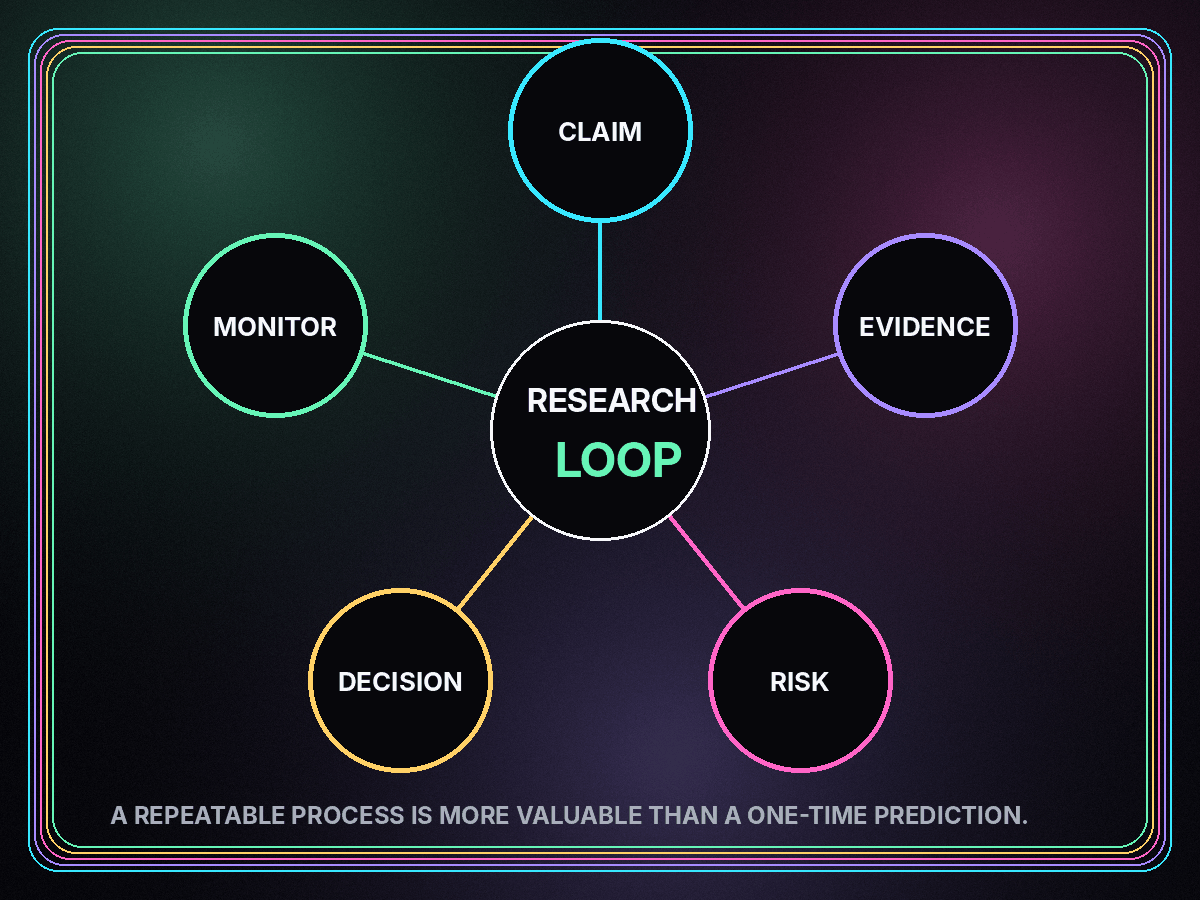
Research loop
Claims enter the loop, evidence changes confidence, risk defines the loss boundary, and monitoring keeps the decision current. The loop remains useful even when the answer is to pass.
Evidence standard
No source answers every question. Independent evidence reduces uncertainty only within its scope, date, method, and assumptions.
Production code, signed records, on-chain data, financial statements, contracts, and repeatable product tests.
Audits, attestations, formal verification, security reviews, legal opinions, and third-party measurements with clear limitations.
Road maps, dashboards, presentations, interviews, governance discussions, and forecasts that require corroboration.
Price, liquidity, funding, basis, and activity can reveal expectations, but they do not by themselves establish utility or value capture.
Each guide is written to support a specific diligence task rather than a general market forecast.
A practical research system for separating network facts, business-model assumptions, token claims, custody risks, and exit constraints before committing capital.
Read the analysis
Learn how to test token supply, emissions, unlock schedules, utility, fee flows, governance, and value capture without confusing a protocol narrative for an investment case.
Read the analysis
A diligence guide to legal claims, asset servicing, cash-flow rights, settlement design, liquidity, oracles, and the gap between a token and the underlying asset.
Read the analysis
A structured way to compare rollups by security model, data availability, sequencing, interoperability, distribution, economics, and durable value capture.
Read the analysis
Map decentralized-finance risk across code, collateral, liquidity, pricing, governance, dependencies, operational controls, and market reflexivity.
Read the analysis
A control framework for private keys, authorization, segregation, recovery, transaction policy, service providers, evidence, and incident response.
Read the analysis