Settlement networks
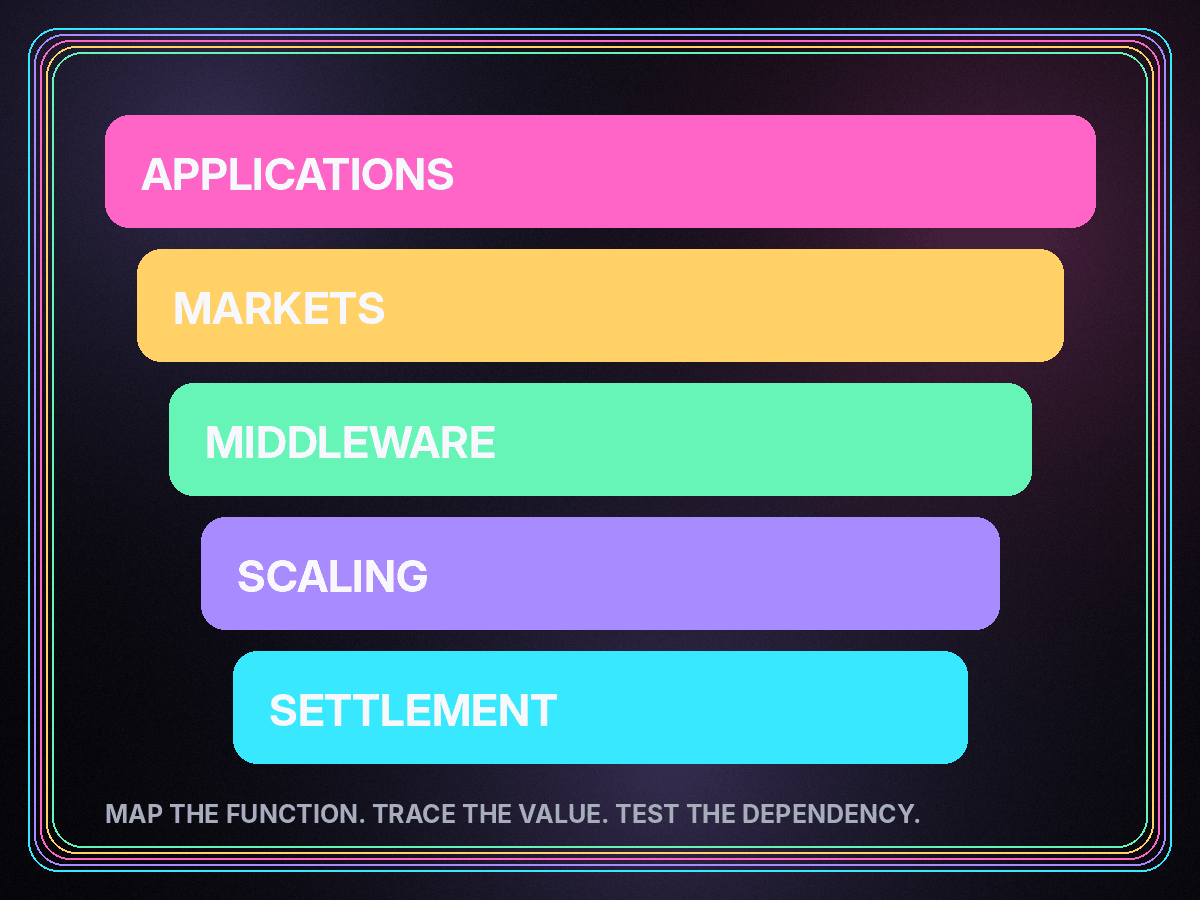
Consensus, finality, block space, validator economics, execution environments, and the base security budget.
Blockchain market map
A functional view of blockchain markets—from settlement and scaling to middleware, financial rails, applications, and the service providers that connect them.
The layers overlap, and many businesses span several. The map is a diligence tool: it clarifies who depends on whom and where economics can migrate.
Consensus, finality, block space, validator economics, execution environments, and the base security budget.
Rollups, sequencing, proofs, data availability, compression, interoperability, and the path back to settlement.
Oracles, bridges, indexing, identity, key management, developer tooling, monitoring, and audit infrastructure.
Stablecoins, tokenized deposits, exchanges, custody, prime services, clearing, collateral, and payment connectivity.
Trading, lending, asset management, gaming, social networks, marketplaces, and domain-specific coordination.
Foundations, treasuries, venture financing, liquid markets, delegates, validators, and the entities that exercise control.
Dependency map
Different assets may rely on one stablecoin, bridge, sequencer, custodian, cloud provider, liquidity venue, or legal outcome. Map shared dependencies before calling a portfolio diversified.
Build the portfolio exposure matrixCapital flow
Activity is not automatically revenue, and revenue is not automatically token value. Follow the complete route.
What recurring action creates demand, and is the user paying directly, indirectly, or through an incentive?
Which participant receives fees, spread, subscription revenue, issuance income, or order flow?
Who pays for security, liquidity, cloud services, compliance, customer support, and capital?
Which token, equity, fund interest, or contractual right participates after costs, dilution, and governance?
A diligence guide to legal claims, asset servicing, cash-flow rights, settlement design, liquidity, oracles, and the gap between a token and the underlying asset.
Read the analysis
A structured way to compare rollups by security model, data availability, sequencing, interoperability, distribution, economics, and durable value capture.
Read the analysis
Map decentralized-finance risk across code, collateral, liquidity, pricing, governance, dependencies, operational controls, and market reflexivity.
Read the analysis
A control framework for private keys, authorization, segregation, recovery, transaction policy, service providers, evidence, and incident response.
Read the analysis
Decompose staking returns into issuance, fees, operating costs, token-price exposure, slashing, liquidity, and the trust assumptions added by providers and liquid tokens.
Read the analysis
Evaluate stablecoins by liability structure, reserve quality, redemption mechanics, liquidity, operational dependencies, governance, and stress behavior.
Read the analysis